

A Freedom Fund. One decade of focus. A 110,000 dollar job walked away from.
That’s the lesson plan I run every term in my night class. Not mine — I’ll be honest about that. It belongs to a reader I’ll call Earl, who let me break his numbers down for the room. He was homeless at 19 and walked away from a 32-year corporate grind at 52 with a 3 million net worth. I don’t tell my students to copy him. I tell them to copy the one thing: a focused, brutal, 10-year sprint.

People hear 3 million and picture Ferraris. Earl’s empire is dirt — the word he uses, and it’s the first thing I write on the board. To a guy who once stole 5 bucks from a lost-and-found for gas money, the money is a shield. It keeps the rain off his family and the stress off his heart. That’s the whole lesson in one line.
The numbers we work with
Before the story, the worksheet. These are the only figures in this lesson, and every one of them is Earl’s own:
Net worth at 52: 3 million. At 41: nearly 200,000 in a 401(k) he barely understood. At 45: exactly 500,000. The vice: 11 to 12 dollars a pack a day, nearly 4,000 a year. The refinance: 100,000 of equity pulled at 2.75 percent. The bridge: a 350,000 Freedom Fund covering a 50,000 annual gap. The job left behind: 110,000 a year.
Nothing here is a product and nothing is a guarantee. It’s a set of numbers we can check against the market’s historical average and see what a slow, boring box does when you stop fiddling with it.
The zombie years: checking the box
Here’s the first half of Earl’s story, and it’s the part most students skip because it’s embarrassing. For 20 years he was a retail grinder — pushing carts, managing stores, spending exactly what he made and drifting into debt, paycheck to paycheck well into his 40s. Homeless twice, including once at 19 after his mother died.
His one saving grace was fear. He checked the box. Auto-enrolled in the 401(k). He didn’t know what an index fund was; he just knew that if the money didn’t go into the lockbox, he’d be living off Pop-Tarts at 70. So between 1994 and 2014 he was what I call a zombie — not an investor, just a body going through the motions of shoplifting and inventory audits while the market did the heavy lifting.
By 41 he looked at the balance and found nearly 200,000 in it. That’s the lesson I hammer home: the first decade of a 401(k) isn’t yours. It’s the market’s.
The pivot: paying the escape fee
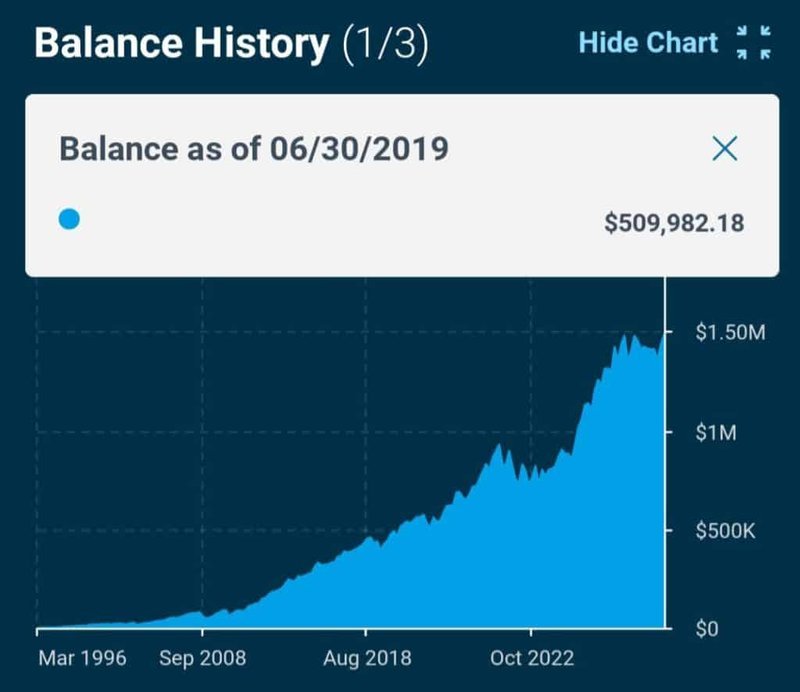
The chart above is the one from Earl’s account — the balance at 500,000, June 2019. He was 45. His wife, who was younger and liked her career, was close behind with her own accounts.
He sat down with a calculator and ran the projections to 59.5 — the standard finish line. If he contributed not another cent and the market kept its historical average, the 500,000 would grow past 2 million by the time he was allowed to touch it. The math told him he was already a future multi-millionaire. The mirror told him he was a current slave.
So he did the thing most experts would call a mistake. He dialed his contributions down to the bare minimum — just enough to capture the company match — and redirected everything else into a taxable account he calls his Freedom Fund. You give up a tax break for liquid cash. He calls the trade an Escape Fee: a deduction today, bought with the power to quit at 52. I flag this step for my students: that’s the one where I’d tell them to find a fee-only advisor before signing anything. The rule is sound, but it’s still an investment decision, and I stop at the boundary line there.
The 11 dollar a day lifeboat
In 2016 his daughters were born. His vices stopped being bad habits and became threats — he was smoking a pack a day at 11 to 12 dollars. That’s nearly 4,000 a year to stay stressed and sick. In 2018, after his son was born, he quit. And here’s the part that lands in the room every time: he didn’t just stop buying cigarettes. He started buying Freedom. That 11 a day went into an index fund.
The worksheet for that step, straight from his numbers: 11 dollars a day, 4,015 a year, and at 9 percent growth over 7 years, 39,145. That’s an entire year of his household’s essential expenses, bought back with money he used to set on fire.
The 100,000 dollar injection and the Rule of 55
By 2020 the sprint was on. When rates hit the floor, most people saw a chance to buy an SUV. Earl saw a loophole: a cash-out refinance on his home at 2.75 percent, 100,000 of equity pulled out and straight into the Freedom Fund. That move, combined with paying off 20,000 of credit card debt from fertility treatments, changed the math forever. By 2024 the Freedom Fund alone had hit 300,000.
And then the bridge. Most people think they have to wait until 59.5. But the IRS Rule of 55 says if you leave your job in or after the year you turn 55, you can tap your current 401(k) penalty-free. Earl was 52. His 350,000 Freedom Fund covered the 50,000 annual income gap for the next few years until that magic age. It’s what let him walk away from the 110,000 job in 2024 and start working part-time for his kids.
What I’d do differently
If I were running Earl’s first decade, I’d have written the numbers down from month one. He was a zombie for twenty years, which worked — but a zombie with a notebook would have made the pivot five years earlier. And I’d have had that Escape Fee move second-opinion’d before he made it, not after.
Lesson card — Time: a 10-year sprint. Cost: the price of a vice, plus one refinance, plus the patience to let a lockbox sit for two decades. Level: anyone who’s spent exactly what they made once.
The debt is the opium, so nuke it. The 401(k) is the cage, so build a liquid bridge in front of it. The vice is a year of your life, so pick which one you want more of. You don’t need 30 years to win. You need one focused decade.
That’s the lesson.