
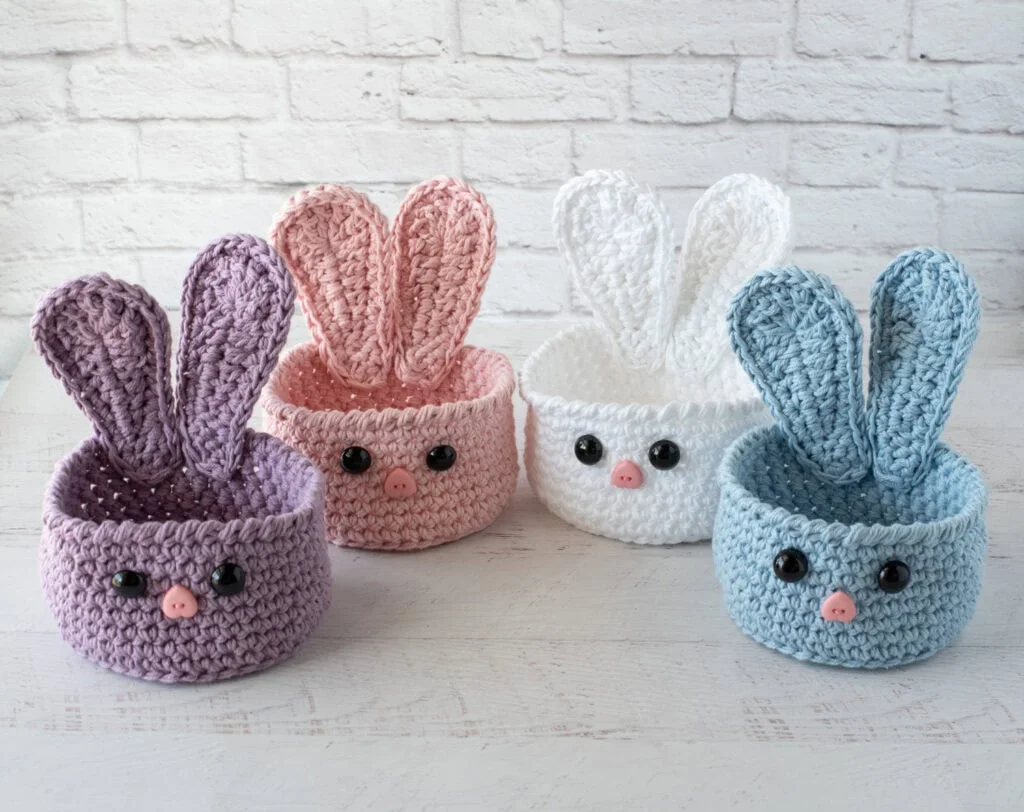
A crochet basket with ears that stand up on their own. One evening apiece. A couple of skeins of cotton and a few buttons.
I made four of them over the run-up to Easter. Not because I needed four — because the second one went so much faster than the first that I couldn’t stop. This is the pattern, and the one thing I’d do differently.
Why two strands of cotton
The basket holds its shape because you work with two strands of worsted-weight cotton held together the whole way through. One strand gives you a floppy side. Two strands give you a wall. That’s the entire structural secret — no wire, no stuffing, no interfacing.
I used a 100% cotton worsted in size 4, 190 yds (174 m) per 100 g skein. Each basket uses about 140 yds, so one skein covers roughly one basket. I bought two skeins per colour I wanted, which is the clean way to plan it: two skeins, two baskets, no mid-project maths.
The colourways I made were white, blush pink, a soft blue, and lilac. Any worsted-weight cotton works as a substitute — a cotton like Peaches & Creme or a similar local shop line is fine, and if you already have worsted cotton in the stash, that’s the cheapest version of this project.
What you need
Materials, per basket:
- Worsted-weight 100% cotton yarn, held two strands together throughout (140 yds per basket; 190 yds per 100 g skein)
- 6.0 mm (US J-10) crochet hook
- Two 5/8 in (16 mm) black shank-style buttons, for the eyes
- One 5/8 in (16 mm) pink heart button, for the nose
- Stitch marker, tapestry needle, scissors
The buttons are the part that trips people up, so a word on that. The eyes look like safety eyes but they aren’t — I went with shank buttons sewn on from the outside, which keeps the inside of the basket smooth. No scratchy plastic backing when you reach in for a chocolate egg. I bought mine at a chain craft store; any shop that stocks shank-style buttons works, and in the UK and EU these are often easier to find than in the US. The heart button is used upside down as the nose, which is a small trick that does a lot of work.
Gauge and abbreviations
Gauge: 6 sc = 2 in (5 cm). In this pattern gauge matters less than usual — the finished size is forgiving — but checking it before round 8 saves you from a basket that’s slightly off when you’re done.
ch = chain · BLO = back loop only · dc = double crochet · hdc = half double crochet · RSC = reverse single crochet · sc = single crochet · sl st = slip stitch · st = stitch · tr = treble crochet
Finished size
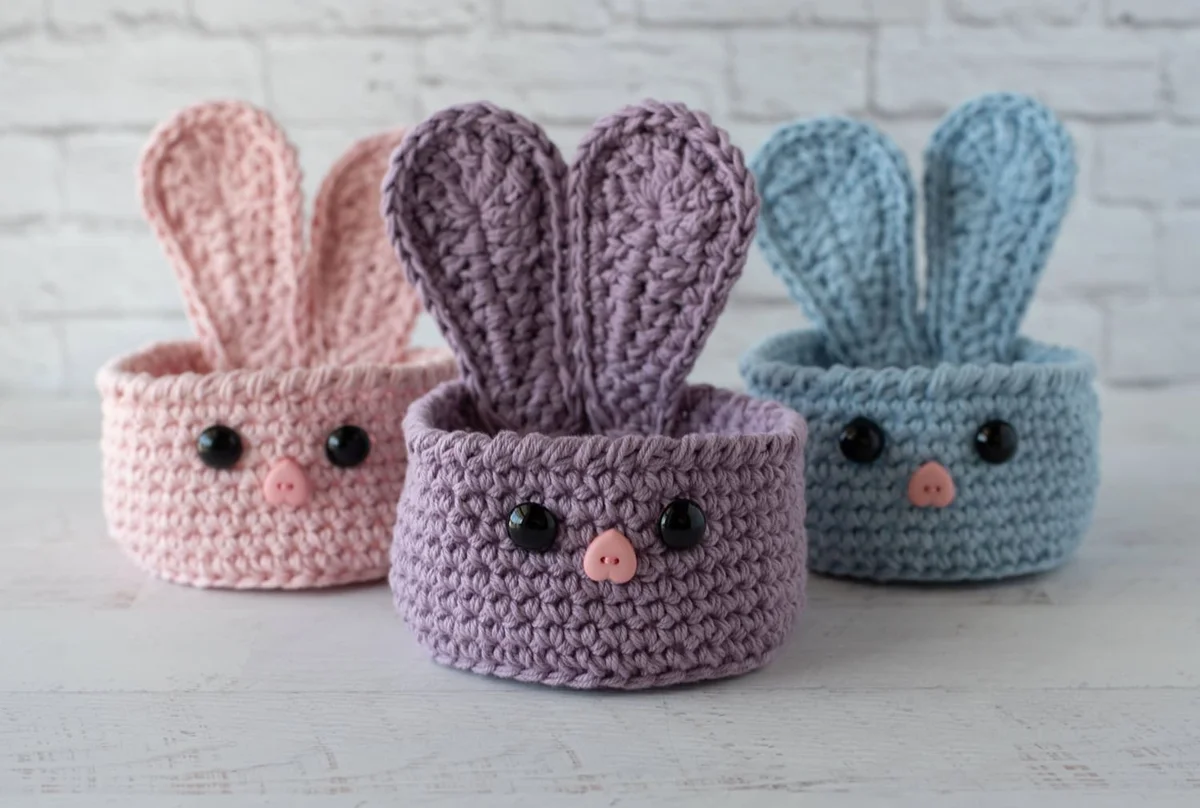
The basket is 2.75 in (7 cm) tall excluding the ears, about 6 in (15 cm) tall including them, and 4.5 in (11.5 cm) wide. Empty, it folds flat for storage, which is the part I didn’t expect to care about until I had four of them.
The basket
Hold two strands of yarn together throughout. Make a magic ring.
R1: 6 sc into ring. Place a stitch marker. Work in continuous rounds. (6 st)
R2: 2 sc in every st. (12 st)
R3: *Sc in next st, 2 sc in next. Repeat from * around. (18 st)
R4: *Sc in next 2 st, 2 sc in next. Repeat from * around. (24 st)
R5: Sc in next st, 2 sc in next. *Sc in next 3 st, 2 sc in next. Repeat from * around until last 2 st, then sc in next 2 st. (30 st)
R6: *Sc in next 4 st, 2 sc in next. Repeat from * around. (36 st)
R7: Sc in next 2 st, 2 sc in next. *Sc in next 5 st, 2 sc in next. Repeat from * around until last 3 st, then sc in next 3 st. (42 st)
R8: Working in the back loop only, sc around. (42 st) — this round is what gives the top edge its clean, slightly ridged finish. If you skip it and work both loops, the rim looks softer and a little uneven.
R9–14: Working in both loops, sc around. (42 st)
R15: Sc around. At the end, sl st to the next st. (42 st)
R16: Ch 1. RSC around. Fasten off, join to the first st of the round, and weave the end through the last few stitches.
The ears
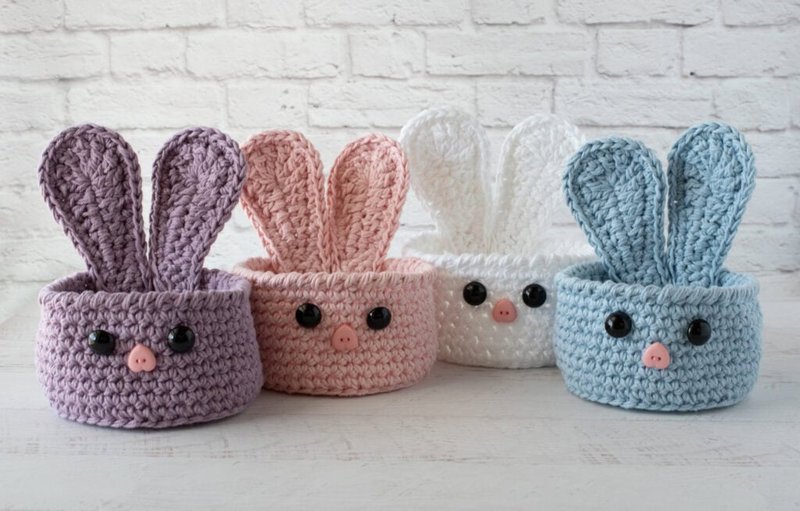
Each ear is two layers — a back and a front — crocheted separately and joined with a final round. That’s what makes the ears stand up on their own. One layer is a floppy flap; two layers, joined, are a structure.
Ear back (make 2):
Hold two strands together. Ch 11. R1: Sl st in the 2nd ch from the hook and the next 2 ch. Sc in next 2 ch. Hdc in next 2 ch. Dc in next 2 ch. 7 tr in the last ch. Rotate the work to the opposite side of the chain: dc in next 2 ch, hdc in next 2 ch, sc in next 2 ch, sl st in next 3 ch. Fasten off.
Ear front (make 2):
Work R1 of the ear back exactly as written, but do not fasten off. Place the back ear behind the front, right sides facing you. Turn the work so you’re going back up the row. R2: Holding both layers together and working through the corresponding stitches on both pieces, ch 1, sc in next 9 st, 2 sc in each of the next 7 st, sc in next 9 st. Join with a sl st to the first sc of the round. Fasten off, leaving a long tail for sewing.
Finishing
Sew the ears to the inside back of the basket with a tapestry needle and one strand of yarn. The base of each ear covers the last 3 rounds of stitches. Sew up and around both ears wherever they touch the basket, pulling firm — the ears carry their own weight.
Sew the button eyes to the outside front, between rounds 13 and 14, with 4 stitches visible between them. Thread a length of matching yarn through the button shank, tie it off on the wrong side, and weave in the ends — that’s faster than sewing the button down with thread and gives a cleaner result.
For the nose: position the heart button upside down, centred between the eyes, and sew it between rounds 12 and 13 with matching thread.
What I’d do differently
My first basket had the ears sewn on a little too high, which made the face sit lower than the rest and look slightly off-balance. On the second one I lowered the seam by a round and it reads correctly. The fix is cheap: if you’re checking as you go, mark the spot before you commit.
Everything else I’d repeat exactly, including the mistake of making a fourth one. I was done by the third.
Lesson card — Time: one evening per basket · Cost: two skeins of worsted cotton per basket, plus three small buttons · Level: beginner, if you can work in the round
My first attempt is in the bin, where it belongs. That’s the lesson.